


After completing my Master’s in Theology and Mission I’ve become even more convinced that in today’s globalised world, we (those in the West) need to update our theological input. In a previous post I shared how theology from the Global South is good news for the Church in the West. As a result I would previously compel as many people as I could that they should broaden their theological diet. However, some feedback was that even though I challenged people to broaden their reading, I never pointed them to anything. So, in this post I’ll point to three different resources to consider, at three different levels. Each resource is either written by or heavily uses majority world theologians to inform their writing. At the very least their bibliographies will prove useful.
INTRODUCTORY
The 3D Gospel: Ministry in guilt, shame and fear contexts - Jayson Georges
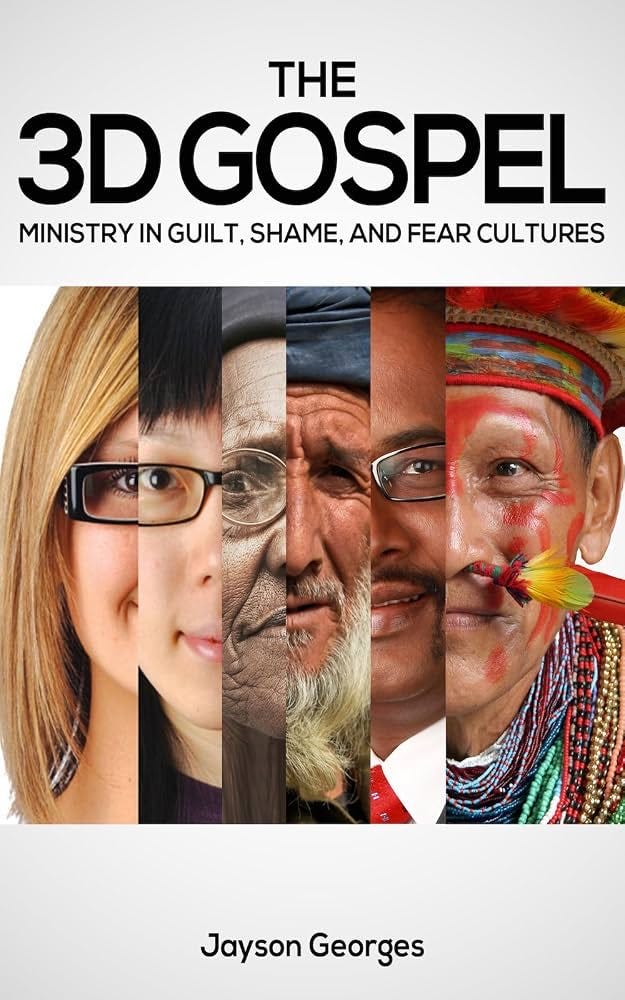
This is a short book that helps understand that most cultures fall within three categories.
The West is Guilt-innocence. Primarily using courtroom or legal analogies. For example - Penal Subsitution Theory.
Asia and the Middle East often function in honour -shame cultures. Where giving honour and avoiding shame is a key part of public life.
Africa and parts of Latin America function within fear-power dynamics. This can often be seen through spiritual power and or earthly authority.
When we think about sermons or books in today’s culture, most centre on the first and very rarely engage with the other two. This is also the case in the majority world due to the transmission of the gospel that came from the West within the colonial era. However, while this guilt-innocence dynamic is clearly evident in scripture, we have come to miss the other dynamics at play within the redemptive story of the cross.
The 3D Gospel helps broaden how we engage with and understand the incredible work of Jesus on the cross and its implications for daily life. It helps us see that the Gospel is able to speak to all cultures and at all times. This is particularly important in today’s globalised world because for example a culture that places a lower value on legality or power may not recognise the significance or the impact of the gospel in their lives if shame is the overriding factor.
I read this book around 10 years ago and it has played a pivotal role in my preaching and pastoring in diverse places. I would argue this is an important theological step to take in order to help us communicate the gospel with even more clarity and faithfulness. Not only does it play a significant part in forming our understanding of salvation but it also can provide a better way to faithfully adhere and apply the Bible to daily life. For example, honour-shame cultures have a strong sense of relationship with others. This understanding when reading 1 Corinthians for instance has much deeper meaning and carries more theological weight when reading passages about sin’s impact others or even how important each member of the body is.
One of the major strengths of this book is the biblical foundation that Georges takes. He evidences scripture to show how all these themes of guilt, shame and fear are addressed.
This is a great place to start for anyone wanting to understand how different cultures engage with the Word of God and what it means to communicate the gospel in a contextually appropriate way.
INTERMEDIATE
Made Flesh: John’s Gospel, Mission and the Global Church - Andy McCullough
I first started reading this on a beach in Cyprus and very quickly became aware that this was not a regular commentary on the Gospel of John. Andy navigates through the book of John thematically but what Andy has impressively done is that he has done his due diligence in understanding the book linguistically, thematically and theologically with a heavy emphasis on contextual understanding shaping his arguments.
“For people who love the Bible, there should be loads of ideas in this book to delight your heart and stimulate your imagination. Biblical interpretation is not a closed book, we haven’t arrived, and contemporary Western theology is neither the peak nor the summation of revelation. But, more importantly, theology exclusively from the Global North is insufficient to understand John’s Gospel. If you only read North Atlantic commentaries on John, there is a great deal of great import that will be missed.“
One of the greatest strengths of this commentary is that the above quote is not simply lip service to broadening our theological diet, but instead every one of the 17 chapters is littered with theological insights from the Global South.
Due to the broad range of voices represented in the book and being done so thematically helps the reader develop a more nuanced and cultural awareness in relation to what particular elements may communicate in scripture and the weight that they carry.
I would highly recommend this to anyone who longs to engage with a global theological community in a focused and rich manner. This work is theologically deep as it is geographically wide.
ADVANCED
Emerging Theologies from the Global South - edited by Mitri Raheb & Mark A. Lamport
In Andy’s quote in the previous section he talks about Western theology neither being the summation of revelation. This is where this work fills that gap.
A couple of chapters that are worth engaging with first, particularly if you are in the UK are: The post-colonial/decolonial option in theology & Middle Eastern Theologies.
One of the main strengths of Emerging Theologies from the Global South is, firstly, it is a much-needed voice for the Global North – making it aware that the Global South has a significant part to play in global theological development and secondly is that it recognises that theological thought is more fluid and being shaped by contextual elements such as linguistic or cultural traditions, rather than something that is static or rigid.
I found it particularly helpful to reframe how Western theologies focus on the persecution of Christians by Islam – which can often be divisive or combative. This short section helped affirm in me a more contextually winsome approach to mission amongst the “cousins”. I’d recommend it because it is able to help give a breadth of what God is doing in the Global South in terms of theological development (there are 32 chapters focusing on various regions in the Global South), which in turn equips me to pastor in a world that is becoming more and more globalised.
I’d recommend it to those who are studying theology and/or those involved in cross-cultural pastoral ministry.
At the very least my hope is that one of these three (if not all three) provide a framework for pastors and theologians to grow in their theological breadth to serve the beautiful global body of Christ.